Your Oklahoma Utility Bill Is a Report Card on Your Home — Here’s How to Read It
Electricity costs in Oklahoma have climbed steadily over the past several years—and more increases are already being proposed.
If you are shopping for a new home right now, that matters more than most people realize. The home you choose will determine how exposed you are to every rate increase that follows.
There is a tool that makes that exposure measurable.
It is called the HERS Index Score—and most homebuyers have never heard of it.
What Is the HERS Index Score?
The Home Energy Rating System, commonly called the HERS Index, is the nationally recognized standard for measuring residential energy efficiency.
Think of it like miles-per-gallon for a car. You would not buy a vehicle without knowing the MPG. A HERS score gives you that same kind of clarity for a home.
- 100 — A home built to the 2006 energy code baseline
- 130+ — Typical older resale homes
- 80–100 — Many new homes built near minimum code
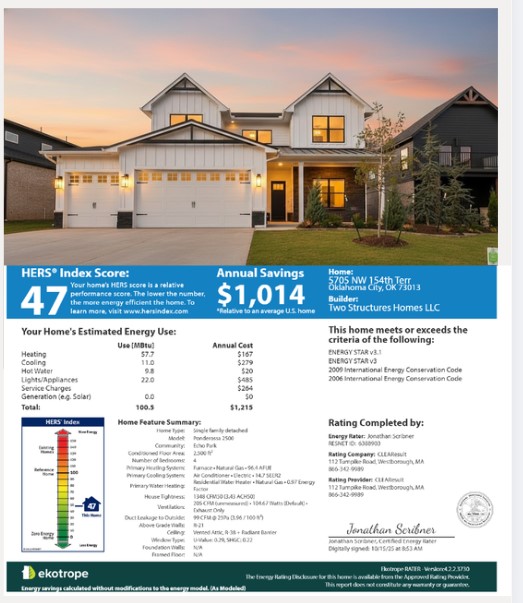
- 40–50 — High-performance homes like Two Structures Homes
- 0 — A net-zero home
The lower the score, the lower the energy use.
A HERS score around 45 represents roughly 55% less energy use than a standard code-built baseline home.
And when a home achieves that without solar, it means the house itself is doing the work.
Why This Matters More in Oklahoma
Oklahoma is one of the most demanding climates in the country for residential construction.
- Summer temperatures regularly exceed 100°F
- Humidity swings are extreme
- Wind loads are significant
- Homes must perform in both intense summer heat and sudden winter cold
A home that leaks air, transfers heat easily, or relies on oversized HVAC equipment will cost more to operate every month.
You may not see those problems during a showing. But you will feel them in comfort, room-to-room temperature swings, and monthly utility bills.
A HERS score tells you whether a home is designed to solve that problem—or simply hide it.

What a HERS Rating Actually Measures
A HERS rating is performed by an independent third-party energy rater, not the builder.
The process includes:
1. Energy Modeling
Plans and specifications are reviewed to predict the home’s performance before construction is complete.
2. On-Site Inspections
Insulation, framing, air sealing, ductwork, and mechanical systems are reviewed during construction.
3. Blower Door Testing
A blower door test measures how much air leaks through the home’s building envelope. Tight homes perform better. Leaky homes cost more to operate.
4. Duct Leakage Testing
Duct leakage testing verifies that conditioned air is reaching the rooms it was designed to serve instead of escaping into unconditioned spaces.
5. Final Score and Documentation
The home receives a verified HERS score and documentation that supports ENERGY STAR® certification and other energy-efficiency programs.
This is not a marketing claim. It is a measured result.
The Difference Between “Energy Efficient” and Measured Performance
Many builders talk about energy efficiency.
Fewer test it.
Even fewer publish the results.
A HERS score in the 70s or 80s can often be achieved with selected upgrades. Getting into the 40s requires the entire home to work as a system.
- Advanced framing to reduce thermal bridging
- Continuous air sealing throughout the home
- Insulation installed without gaps, compression, or voids
- Sealed and properly designed duct systems
- HVAC sized using real load calculations
- Windows selected for Oklahoma’s climate
- Ventilation designed for comfort, health, and efficiency
It is not one upgrade. It is everything working together.
What Is Built Into Every Two Structures Home
Our HERS scores in the 40–50 range are not accidental. They are the result of consistent, verified building practices.
2×6 Exterior Wall Framing
Deeper wall cavities allow for more insulation and a stronger building envelope, which is especially important in Oklahoma’s demanding climate.
Windows Designed for Oklahoma’s Climate
Our windows are selected to reduce solar heat gain and improve comfort during extreme summer conditions.
But more importantly, they are part of a fully designed and sealed building envelope—not a standalone upgrade.
Sealed, Designed HVAC Systems
We do not simply install HVAC equipment. Each system is designed for the specific home, properly sized, and installed with sealed ductwork so conditioned air gets where it is supposed to go.
Tankless Water Heating and Balanced Ventilation
Tankless water heating helps reduce standby energy loss, while balanced ventilation brings fresh air into a tighter home in a controlled, efficient way.
Third-Party Verification
Every Two Structures home is tested, rated, and certified through ENERGY STAR® and OG&E’s Positive Energy Program.
Not some homes. Every home.
What to Ask Before You Choose a Builder
If you are comparing builders in Edmond, Deer Creek, Mustang, or the Oklahoma City metro, ask these questions:
- What is your average HERS score?
- Is every home tested, or only selected models?
- Do you perform blower door testing?
- Do you test duct leakage?
- Can I see a real HERS report from a completed home?
If a builder cannot answer these clearly, the home is likely being built to minimum code and marketed as efficient.
The Financial Impact of a High-Performance Home
The check you write at closing is not the total cost of homeownership.
A high-performance home can help reduce monthly utility costs by lowering the amount of energy needed to heat, cool, and operate the home.
For many homeowners, that can mean meaningful savings every month—and as utility rates continue to rise, the value of a tighter, better-built home becomes even more important.
Lower utility bills are not an accident. They are the result of better design, better construction, and verified performance.
Built Better. Verified. Every Time.
You should not have to take a builder’s word for performance.
You should be able to measure it.
That is what a HERS score provides—and that is what every Two Structures home delivers.
Before you choose a builder, ask to see a HERS report.
If they cannot show you one, the home is not being measured.
If you want to see what a verified high-performance home actually feels like—and what it can mean for comfort and utility costs—we would be glad to show you.
Call or text: (405) 509-9435
Email: sales@twostructureshomes.com
Explore available homes: twostructureshomes.com/inventory
Serving Deer Creek, Edmond, Mustang, and surrounding Central Oklahoma communities.