
Understanding Low HERS® Scores: What Sub-45 Really Means
Achieving a low HERS® score is much harder than most buyers realize.
At first glance, the difference between a HERS® 100 home and a HERS® 45 home may sound like “just a number.” But in reality, lowering a home's HERS® score becomes increasingly difficult with every improvement.
Going from a HERS® 100 to an 80 is far easier than going from a 57 to a 47.
The lower the score gets, the more important every detail becomes — air sealing, HVAC engineering, duct design, insulation installation quality, ventilation strategy, window performance, and overall building execution.
That is why truly low HERS® scores are rarely achieved by accident.
They are the result of systems working together.
If you are new to HERS® ratings and how the scoring system works, our earlier articles cover the fundamentals and how buyers can compare homes using verified testing data:
- Understanding Energy-Efficient Homes: What Makes a Home Efficient?
- What Is a Good HERS® Score? How to Compare Energy-Efficient Homes
- Energy-Efficient Homes in Oklahoma: Why a HERS® Rating Matters
A Home Is a System — Not a Collection of Products
One of the biggest misconceptions in homebuilding is that energy efficiency comes from a few upgraded products.
Many buyers assume high-performance construction simply means adding better windows, more insulation, or a higher-efficiency HVAC unit.
In reality, homes perform well when all the systems work together correctly.
A home can have expensive windows and still perform poorly if air sealing is inconsistent. A home can have a high-efficiency HVAC system and still struggle with comfort if duct leakage is excessive. A tightly sealed home without proper ventilation can create humidity and indoor air quality problems.
That is why low HERS® scores are about far more than product selection.
They are about execution.
Most of these details are invisible during a walkthrough, but homeowners experience the results every day.
Why Air Sealing Matters So Much
One of the biggest factors affecting home performance is uncontrolled air leakage.
Every gap around framing, penetrations, windows, attic transitions, plumbing, electrical components, and ductwork creates opportunities for conditioned air to escape and unfiltered outside air to enter.
In Oklahoma, those leaks become even more consequential because homes experience:
- Long cooling seasons
- Extreme summer heat
- Strong winds
- Humidity swings
- Dust and allergens
- Sudden temperature changes
Excessive air leakage often leads to:
- Higher utility bills
- Uneven temperatures
- Drafts
- Humidity control issues
- More HVAC runtime
- Increased dust and allergen infiltration
That is why blower door testing has become such an important part of high-performance construction.
Blower door testing measures how much uncontrolled air leakage exists within the home's envelope. Lower leakage numbers generally indicate tighter construction and better overall control of the indoor environment.
Why HVAC Design Matters More Than Bigger Equipment
Many homeowners assume a larger HVAC system automatically creates a more comfortable home.
In reality, oversized HVAC equipment is often one of the biggest contributors to comfort and humidity problems.
When systems are oversized, they frequently short-cycle — turning on and off too quickly instead of running long enough to properly manage humidity and maintain even temperatures.
That can leave homes feeling cool but still uncomfortable.
Proper HVAC engineering includes:
- Manual J load calculations
- Proper equipment sizing
- Duct layout and airflow design
- Duct leakage control
- Ventilation planning
- Humidity management
In higher-performing homes, the HVAC system is designed to work with the building envelope instead of constantly fighting against it.
Projected Scores vs. Verified Scores
This is one of the most misunderstood parts of HERS® ratings.
A projected HERS® score is based on plans, specifications, and energy modeling before the home is complete. A verified HERS® score is achieved after construction through field inspections, blower door testing, duct leakage testing, and third-party verification.
That distinction matters.
Many homes may look impressive on paper. But achieving those numbers in the real world requires careful execution throughout the entire construction process.
At Two Structures Homes, we believe buyers deserve independently verified performance data — not just projections.
Real-World Examples
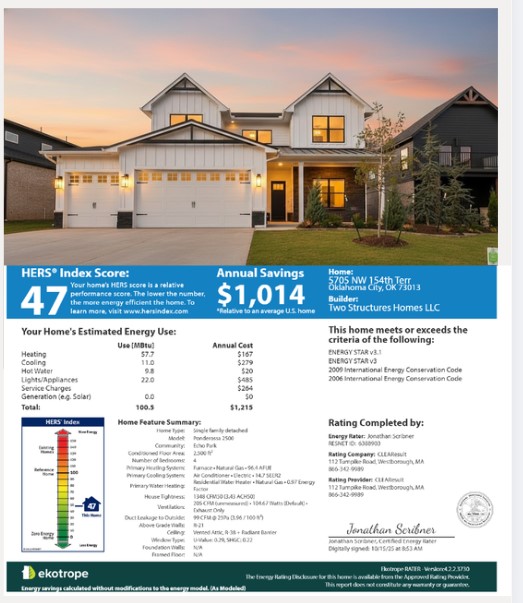
A recent Two Structures Deacon 1394 home at 524 E Grumman Dr. in Midwest City achieved a final verified HERS® score of 45 through independent third-party testing by CLEAResult, a certified RESNET rating company. The home is also ENERGY STAR® v3.2 certified and projected to save approximately $710 annually compared to an average U.S. home.
The verified report included:
- Blower door tested house tightness of 1,148 CFM50 (5.49 ACH50)
- R-21 wall insulation
- R-38 attic insulation with radiant barrier
- 15.5 SEER2 HVAC system
- Low solar heat gain windows (SHGC 0.22)
- Verified duct leakage testing
We also recently received a projected HERS® score of 43 for a home in Mustang Park prior to construction completion, based on independent plan review by a certified RESNET rater. Final as-built scores are verified after construction through field inspections and diagnostic testing.
That projected report demonstrates what is possible when the entire home is engineered together from the beginning — insulation strategy, air sealing, duct design, HVAC sizing, window performance, and ventilation planning all working as a complete system.
But projected scores are only the beginning.
The final as-built verification is where field execution matters most.
Why Lower Scores Become Increasingly Difficult
As homes become more efficient, every additional improvement becomes harder to achieve.
At higher HERS® scores, larger improvements are often easier to accomplish through basic upgrades. But once homes move into the 40s, small weaknesses become magnified.
A minor air sealing gap, slightly elevated duct leakage, inconsistent insulation installation, or poor HVAC balancing can prevent a home from achieving ultra-low performance targets.
That is why lower HERS® scores require a much more disciplined building process.
The difference between average construction and high-performance construction is often found in details buyers never fully see during a walkthrough.
Performance Is Experienced After Move-In
Most buyers fall in love with a home based on what they immediately notice — the kitchen, flooring, lighting, countertops, curb appeal, and layout.
But long after move-in day, homeowners live with the performance of the home itself.
That means:
- How evenly temperatures stay throughout the house
- How hard the HVAC system has to work
- How well humidity is controlled
- How much dust and outside air enter the home
- How consistent utility costs remain over time
- How comfortable the home feels during Oklahoma's toughest weather conditions
Those experiences are often determined by the systems behind the walls.
That is why we continue investing in testing, verification, HVAC engineering, air sealing, and building science — because true performance is something homeowners experience every single day after the excitement of move-in day fades.
The difference between a builder who talks about efficiency and one who can hand you a signed certificate is measurable.
If you would like to review HERS® certificates, blower door testing results, ENERGY STAR® verification reports, or learn more about how Two Structures Homes approaches high-performance construction, contact our team — we will walk you through them.